
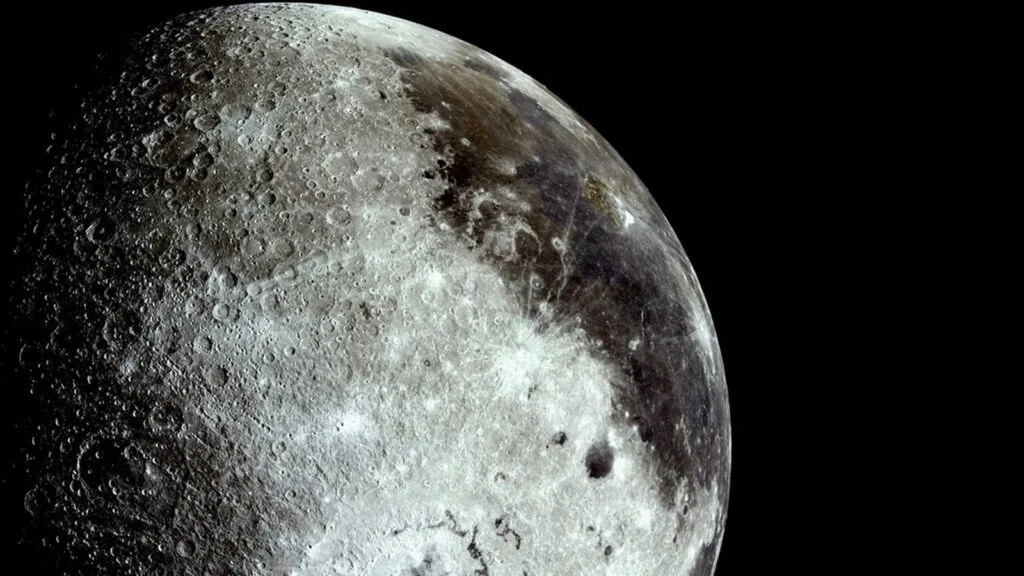
The astronauts on NASA’s Artemis II mission saw a much more colorful landscape during their close flyby of the moon than they had expected. The “yellowish yellow” and “mud green” tones the crew encountered on the moon’s surface were revealed in a new report. The area known as the Aristarchus Plateaus is located on the side of the moon facing Earth. This wide and high terrain is one of the most densely populated areas of the moon’s oldest volcanic features. It contains dark lava deposits and colorful volcanic glass particles. Surprised by the distinct yellow tones she encountered in the area, mission specialist Koch described the plateau as “yellow snow mountains.” She described the bright “snow” of the craters as “the moon’s yellowed cheek.” Pilot Glover shared his observations while filming the area: “Now there are so many colors. There’s also green. Especially in Aristarchus and to the north, I see brown stripes running down.” According to the report’s authors, these colorful tones can be associated with volcanic glass particles rich in titanium and magnesium, similar to those found in different regions of the moon. These colorations could provide clues for future missions to identify landing and exploration sites. Another colorful area that caught the crew’s attention was a massive impact crater. Measuring about three times the size of Massachusetts, this young and highly segmented crater covers both the visible and invisible sides of the moon. Rarely visible from Earth, the structure completely obscured the area as the crew entered orbit behind the moon. Mission commander Wiseman said the structure “created chaos throughout the entire area.” As they passed through the wide basin, the crew spotted gray, brown, tan, and green tones. Koch saw “almost mud-like colors” on the outer rim of the basin, while Glover described a landscape of white dust-like deposits on the slopes and peaks of the mountains. The crater chains moving away from the impact center gave Koch the impression of “bubbles rising from under the water.”
These observations may seem random, but the Artemis II team spent more than two years training to study and describe the Moon’s geology. This included individual and classroom lectures, simulated flight transitions, and reading “reference materials of their choice” during the journey in the Orion capsule. The report emphasizes that this training enabled the team to acquire much more scientific knowledge than automated cameras or spacecraft can provide. The report authors note that “the Artemis II mission demonstrated the extraordinary value of human observation and cognition as a scientific entity in planetary exploration.” Unlike cameras, which capture isolated moments and often narrow scene views, human observers continuously interpret their surroundings, combining real-time visual perception with contextual understanding. While the mission team transmitted this view to mission control, Glover described the sight as “quite a stunning view.”
Bu gelişme hakkında düşüncelerinizi, donanım deneyimlerinizi veya sorularınızı Topluluk Forumumuzda paylaşın.
























OKUYUCU TOPLULUĞU
0 değerlendirme
Deneyimlerinizi paylaşabilirsiniz; tanı, tedavi veya acil durum için yorumlar yerine sağlık uzmanına başvurun.